What Is a Concluding Sentence? Examples & Starters
Introduction
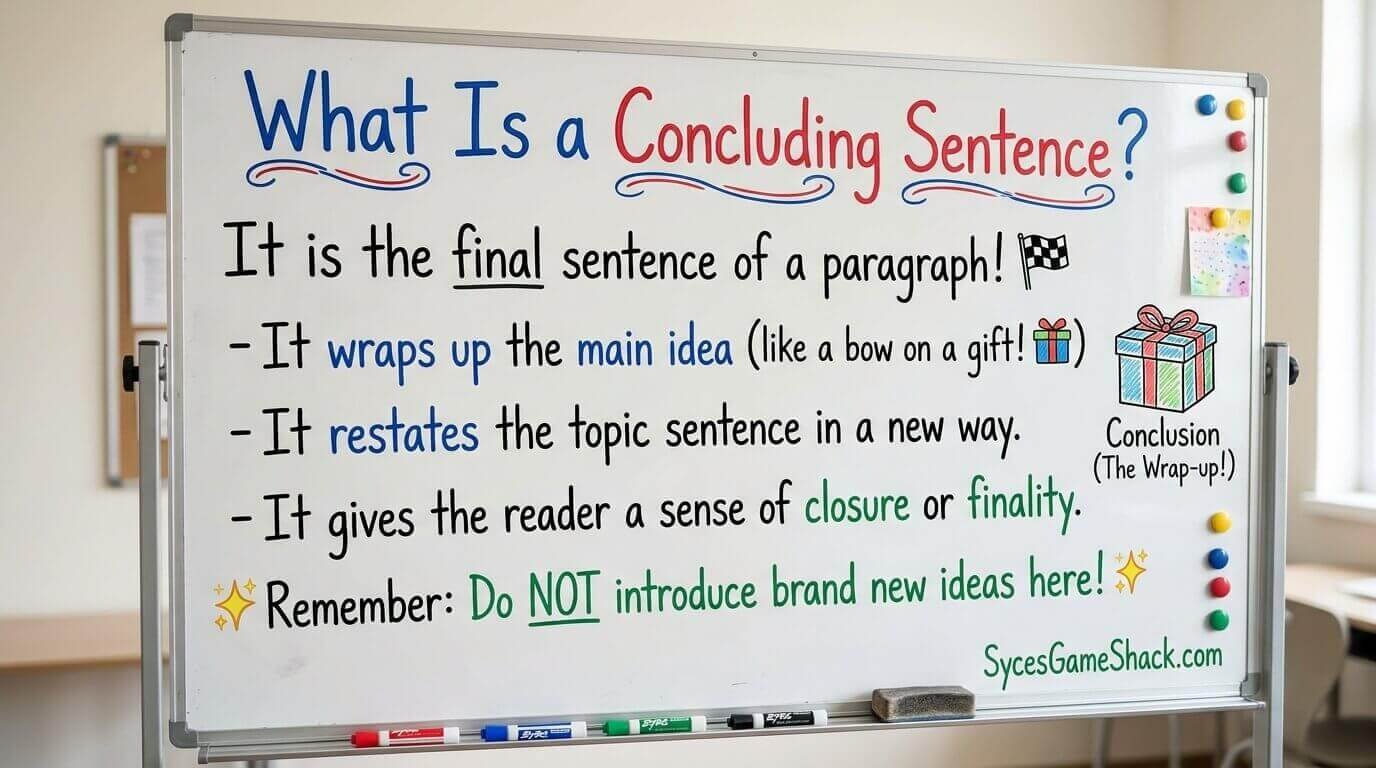
What is a concluding sentence? It is the last sentence of a paragraph. It wraps up the main idea, gives the reader a sense of closure, and shows that the paragraph has reached its goal.
Without one, a paragraph can feel unfinished, like a song that stops mid-note. This guide explains what a concluding sentence is, how to write one in four simple steps, which starters work best, and gives you more than 30 examples you can learn from today.
Concluding Sentence Definition
What is a Concluding Sentence, also called a closing sentence or clincher, is the final sentence in a paragraph. It restates the main point in fresh words, summarizes the key idea, or leaves the reader with a final thought. It does not introduce a new idea.
Example paragraph ending: “Regular exercise improves heart health, lifts mood, and builds strength. For these reasons, a daily walk is one of the simplest ways to improve your life.”
Why a Concluding Sentence Matters
- It gives the paragraph a clear ending.
- It reminds readers of your main point.
- It helps the reader move smoothly to the next paragraph.
- It makes your writing look organized and complete.
- It earns marks in school exams, essays, and writing tests.
The Three Parts of a Strong Paragraph
| Part | Job | Position |
|---|---|---|
| Topic sentence | Introduces the main idea | First |
| Supporting sentences | Give facts, reasons, and examples | Middle |
| Concluding sentence | Wraps up the idea | Last |
How to Write a Concluding Sentence in 4 Steps
- Reread your topic sentence. Your ending must connect back to it.
- Pick the main message. Ask yourself what the reader should remember.
- Reword it. Do not copy the topic sentence. Use fresh words that show growth in the idea.
- Add a closing touch. Link to the next paragraph, give a final thought, or add a call to action.
What a Good Concluding Sentence Does and Does Not Do
| It Should | It Should Not |
|---|---|
| Restate the main idea in new words | Add a brand-new idea |
| Stay short and clear | Repeat the topic sentence word for word |
| Match the tone of the paragraph | Apologize, such as “I think maybe this is right” |
| Leave a final thought | Announce itself, such as “This paragraph was about…” |
Concluding Sentence Starters
What Is a Concluding Sentence Starter? A concluding sentence starter signals that the paragraph is ending. Choose one that fits your tone.
| Tone | Starters |
|---|---|
| Formal and academic | In summary, Ultimately, Consequently, Therefore, Thus |
| Neutral | Overall, In short, All in all, As a result |
| Persuasive | Clearly, Without doubt, It is time to, For these reasons |
| Conversational | So, In other words, The takeaway is simple |
A starter is optional. Strong. What is a Concluding Sentence can work perfectly without one.
Concluding Sentence Examples by Paragraph Type
Descriptive Paragraphs
- Topic: The old market comes alive every Sunday morning.
Concluding: By noon, the whole street hums with color, sound, and the smell of fresh bread. - Topic: My grandmother’s kitchen was the warmest room in the house.
Concluding: Even now, the scent of cinnamon takes me straight back to her table.
Narrative Paragraphs
- Topic: Missing the last bus taught me an unexpected lesson.
Concluding: That long walk home showed me that a small setback can lead to a great memory. - Topic: My first day at the new school felt endless.
Concluding: By evening, I realized that being new was less scary than I had imagined.
Informative Paragraphs
- Topic: Honeybees play a major role in growing our food.
Concluding: Protecting bees means protecting a large part of our own food supply. - Topic: Sleep affects memory, mood, and health.
Concluding: A good night’s rest is not a luxury but a basic need.
Persuasive Paragraphs
- Topic: Schools should start the day later.
Concluding: Giving students extra sleep is a small change that could improve learning for everyone. - Topic: Every town needs more public parks.
Concluding: Green spaces make communities healthier, friendlier, and stronger.
Compare and Contrast Paragraphs
- Topic: Cats and dogs make very different pets.
Concluding: In the end, the right pet depends on whether you want independence or constant company. - Topic: Reading a book and watching its film version are two distinct experiences.
Concluding: Each offers its own pleasure, and the best choice depends on what you value most.
Academic and Science Paragraphs
- Topic: Plants make food through photosynthesis.
Concluding: Without this process, life on Earth could not survive. - Topic: Climate change is raising sea levels worldwide.
Concluding: Acting now will reduce the risks that coastal communities face in the future.
Business and Email Paragraphs
- Topic: Our new scheduling tool will save the team time.
Concluding: I am confident this change will make our week easier and more productive. - Topic: Customer feedback shows delivery delays are the top complaint.
Concluding: Fixing delivery speed should be our first priority this quarter.
More Concluding Sentences Using Starters
- In summary, daily reading builds vocabulary, focus, and imagination.
- Overall, teamwork turns hard tasks into achievable goals.
- Therefore, saving a little each month is the surest path to financial security.
- As a result, the town became a model for clean energy.
- Ultimately, kindness costs nothing but changes everything.
- In short, preparation is the key to confident public speaking.
- For these reasons, students should learn a second language early.
- All in all, the trip was exhausting, but entirely worth it.
- Clearly, recycling is a habit every household can adopt.
- In other words, healthy food gives your body the fuel it needs.
- Thus, regular practice is the real secret behind talent.
- Consequently, the experiment confirmed our original theory.
Weak vs Strong Concluding Sentences
| Weak | Why It Fails | Stronger Version |
|---|---|---|
| “That is all I have to say about dogs.” | Announces the ending, adds no value | “Dogs earn their place in our homes through loyalty and love.” |
| “Exercise is good. Exercise is good for you.” | Repeats itself | “A little movement each day pays off for life.” |
| “Also, pizza is tasty.” | Adds a new, unrelated idea | “Clean parks make the whole neighborhood a better place.” |
| “I hope this paragraph was okay.” | Sounds unsure | “Reading every day can transform how you think.” |
| “The end.” | Gives no closure to the idea | “Patience, then, turns small efforts into big results.” |
Concluding Sentence vs Conclusion Paragraph vs Topic Sentence
| Term | Where It Appears | Purpose |
|---|---|---|
| Concluding sentence | End of a single paragraph | Closes that paragraph’s idea |
| Conclusion paragraph | End of an essay | Sums up the whole essay |
| Topic sentence | Start of a paragraph | Introduces the paragraph’s idea |
Types of Concluding Sentences
Not every ending works the same way. Choose the type that fits your purpose:
- Restatement: repeats the main idea in new words. Example: “Clearly, regular practice makes any skill stronger.”
- Summary: pulls together the key points. Example: “Between lower costs, cleaner air, and quieter streets, electric buses benefit everyone.”
- Prediction: looks ahead. Example: “If cities keep investing in bike lanes, traffic will ease within a decade.”
- Call to action: tells the reader what to do. Example: “Start saving today, even if the amount is small.”
- Transition: prepares for the next paragraph. Example: “With the problem clear, we can now explore possible solutions.”
Tips for Students and English Learners
- Write your topic sentence first, then plan the ending before you write the middle.
- Keep your vocabulary simple. A short, clear closing beats a complicated one.
- Read the paragraph aloud. If the last sentence feels like a natural stop, it works.
- Keep a personal list of starters and rotate them so your writing never feels repetitive.
Common Mistakes to Avoid
- Adding new information. Save new ideas for a new paragraph.
- Copying the topic sentence. Rephrase it instead.
- Making it too long. One clear sentence is usually enough.
- Using tired phrases. Avoid overusing “In conclusion” in every paragraph.
- Changing tone. Keep the same style from beginning to end.
Quick Checklist Before You Finish a Paragraph
- Does it connect to my topic sentence?
- Does it rephrase rather than repeat?
- Does it avoid new ideas?
- Is it short, clear, and in the same tone?
- Does it help the reader move on?
Practice: Write the Concluding Sentence
Read each short paragraph idea and write a What Is a Concluding Sentence. Then compare with the sample answers.
- Topic: Walking to school keeps students active and alert.
- Topic: Public libraries offer free books, computers, and quiet study space.
- Topic: Learning to swim can save lives.
Sample answers: 1. A simple morning walk gives students a healthier start to every school day. 2. Libraries give everyone in the community an equal chance to learn. 3. Swimming is a skill that protects both you and the people around you.
FAQs
1. What is a concluding sentence in simple words?
It is the last sentence of a paragraph that wraps up the main idea and gives the reader a feeling of closure.
2. What is the purpose of a concluding sentence?
It reminds readers of the main point, closes the paragraph neatly, and helps them move to the next idea.
3. How long should a concluding sentence be?
Usually one clear sentence. Two short sentences are acceptable if the paragraph is long.
4. Should I always use “In conclusion”?
No. It is optional and often overused. Try varied starters such as “Overall,” “As a result,” or “Ultimately.”
5. Can a concluding sentence ask a question?
Yes, a thoughtful question can work in persuasive or reflective writing, as long as it does not open a new topic.
6. Is a concluding sentence the same as a conclusion?
No. A concluding sentence ends one paragraph, while a conclusion is the final paragraph of an entire essay or article.
7. Can I add a new idea in a concluding sentence?
No. New ideas confuse the reader. Place them in a separate paragraph instead.
8. Does every paragraph need a concluding sentence?
In academic and exam writing, yes. In casual writing, short paragraphs may flow without one, but a clear ending still improves clarity.


One Comment