Grammar vs Vocabulary: What’s the Difference (and Which Matters More?)
If you are learning English, you have probably heard teachers talk about grammar vs vocabulary as if they are two separate subjects. They are related, but they are not the same thing. Understanding the difference between grammar and vocabulary helps you study smarter, write better sentences, and speak with more confidence.
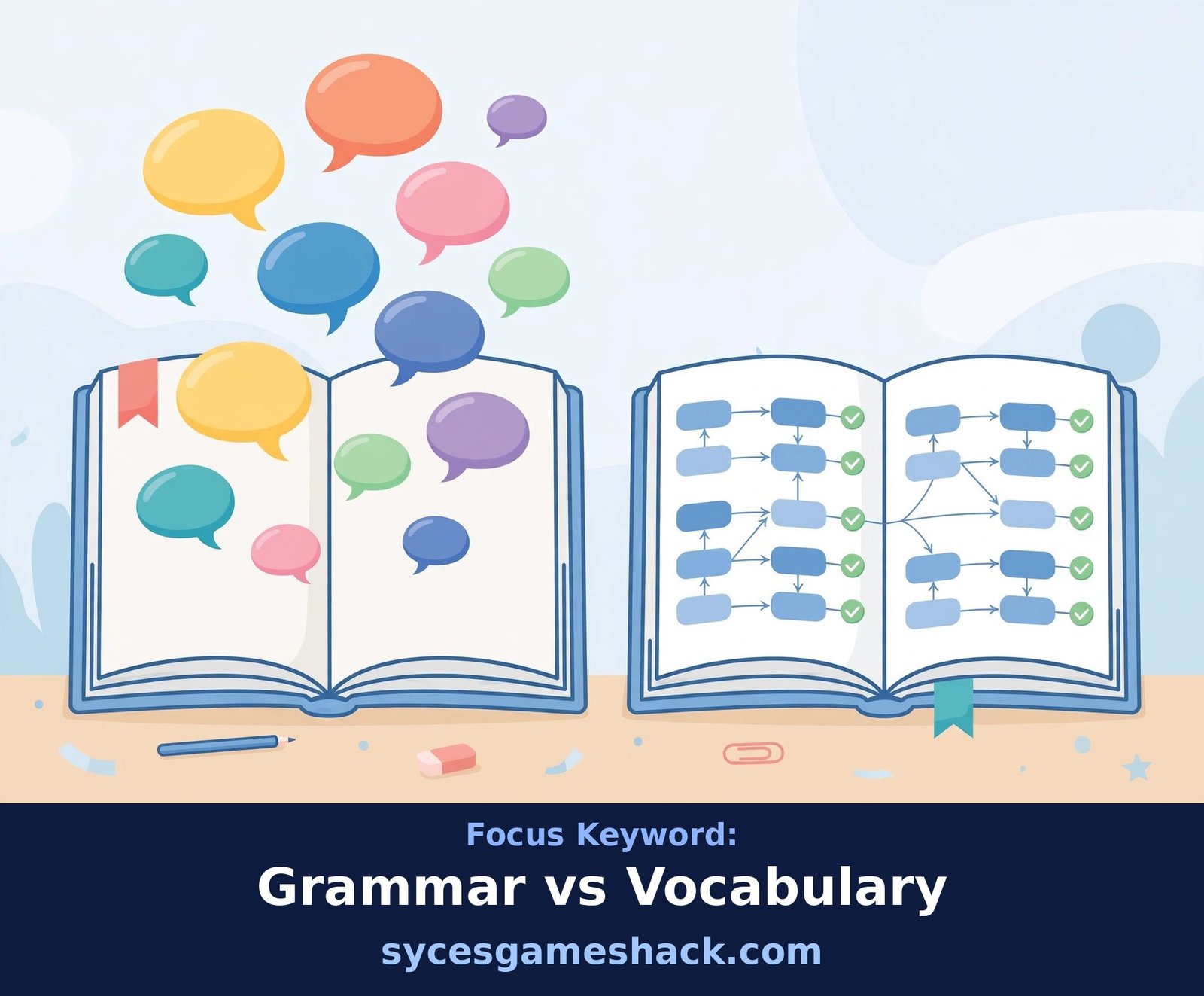
In simple words, vocabulary is the words you know, and grammar is the rules you use to put those words together. One gives you the building blocks. The other tells you how to build with them.
What Is Vocabulary?
Vocabulary means all the words of a language that a person knows and uses. Your vocabulary includes everyday words like “happy,” “run,” and “house,” as well as advanced words like “enormous,” “negotiate,” and “consequence.”
Vocabulary is usually divided into two types:
Active Vocabulary
These are the words you can use correctly in speaking and writing without thinking too hard. For most people, active vocabulary is smaller than passive vocabulary.
Passive Vocabulary
These are the words you understand when you read or hear them, but you do not use them yourself yet. When you read a sentence like “The instructions were ambiguous,” you may understand “ambiguous” from context even if you would never say it.
What Is Grammar?
Grammar is the system of rules that controls how words are arranged in a sentence. Grammar covers word order, verb tenses, subject-verb agreement, articles, prepositions, punctuation, and sentence structure.
For example, grammar is the reason we say “She goes to school” instead of “She go to school,” and “I have eaten” instead of “I have ate.” The words are almost the same, but the grammar changes whether the sentence is correct.
If you want to see grammar rules in action, our guide on whether you can start a sentence with “but” shows how one common rule actually works in real writing.
Grammar vs Vocabulary: The Key Differences
Meaning: Vocabulary is the words of a language; grammar is the rules for arranging words.
Focus: Vocabulary is what you say; grammar is how you say it.
Example: The words “big, huge, enormous, massive” are vocabulary. Saying “The house is big” (not “Big the house is”) is grammar.
Learned by: Vocabulary grows through reading, listening, and word lists. Grammar grows through practice, patterns, and correction.
Mistakes sound different: A vocabulary mistake sounds like “I need a… thing for water” (a missing word). A grammar mistake sounds like “I goes to market yesterday” (a wrong form).
A helpful picture: vocabulary is like the bricks, and grammar is like the plan and cement. Bricks without a plan make a pile. A plan without bricks builds nothing.
Can You Communicate With Only One of Them?
Strong Vocabulary, Weak Grammar
Imagine a tourist saying: “Yesterday I go market, buy apple, very good.” The grammar is wrong, but you still understand the message. Good vocabulary often saves communication even when grammar is weak.
Strong Grammar, Weak Vocabulary
Now imagine someone who knows perfect sentence structure but very few words: “I want to… I want to buy the… thing.” The grammar cannot help because the key words are missing. This is why beginners are usually told to learn useful words first.
In short, vocabulary carries the meaning, while grammar makes the meaning clear, polite, and professional.
Which One Should You Learn First?
For beginners, vocabulary usually comes first. Learning the 500 to 1,000 most common English words lets you understand a large part of everyday conversation. After that, basic grammar — present tense, past tense, questions, and negatives — gives your words structure.
For students, writers, and exam candidates, grammar becomes more important. In school exams, job applications, and professional emails, small grammar mistakes can change how your work is judged, even when your vocabulary is strong.
The honest answer is that you need both, but in stages: at the beginner stage focus about 70% on vocabulary and 30% on basic grammar; at the intermediate stage balance them equally; at the advanced stage refine grammar for accuracy and style while still growing vocabulary.
How to Improve Both Together
The good news is that grammar and vocabulary grow best together, not separately.
- Read short texts daily. Notice new words and how sentences are built at the same time.
- Learn words in sentences, not alone. “Make a decision” teaches you a phrase and its grammar together.
- Write a few sentences every day. Writing forces you to use both skills at once.
- Listen and repeat. Songs, shows, and conversations show how native speakers combine words naturally.
- Review your mistakes. Keep a small notebook of errors you repeat and fix them one by one.
Common Confusions Between Grammar and Vocabulary
Some problems look like grammar mistakes but are actually vocabulary problems, and the opposite also happens.
- Choosing between “borrow” and “lend” is a vocabulary issue.
- Saying “He don’t like it” is a grammar issue (subject-verb agreement).
- Using “make a photo” instead of “take a photo” is a vocabulary and collocation issue.
- Forgetting the past tense “went” and saying “goed” is a grammar issue.
Knowing which type of mistake you made helps you fix it faster.
Conclusion
Grammar vs vocabulary is not a competition. Vocabulary gives you the words to express ideas, and grammar arranges those words so people understand you correctly. Start with useful words, add grammar step by step, and practice both in real sentences. That combination is what turns basic English into confident English.
FAQs
What is the difference between grammar and vocabulary?
Vocabulary is the set of words you know; grammar is the set of rules for arranging those words into correct sentences. Vocabulary answers “what words exist,” while grammar answers “how do I use them correctly.”
Which is more important, grammar or vocabulary?
Both are important, but vocabulary is usually more useful at the beginning because words carry the main meaning. As your level grows, grammar becomes equally important for accuracy, exams, and professional writing.
Can I speak English with vocabulary but no grammar?
Yes, people will often understand you, because words carry most of the meaning. However, weak grammar can cause confusion, sound unprofessional, and limit you in exams and jobs, so grammar should not be ignored.
How can I improve my vocabulary and grammar at the same time?
Read short English texts daily, learn new words inside example sentences, write a few sentences every day, and review your common mistakes. Learning words in real sentences teaches vocabulary and grammar together.
Is spelling part of grammar or vocabulary?
Spelling is usually grouped with vocabulary and mechanics rather than grammar itself, because it concerns how individual words are written. Grammar is about how words work together in sentences.






One Comment