Is vs Are: Simple Rules, Examples & Practice Quiz
Introduction
Few grammar choices come up as often as is vs are. You use one of them in almost every conversation, email, and essay, yet it is easy to hesitate when the sentence gets tricky.
Is it “the team is” or “the team are”? “There is” or “there are”? “Everyone is” or “everyone are”? This guide gives you the simple rule first, then walks through every common tricky case with clear examples, a list of mistakes to avoid, and a practice quiz with answers.
Quick Answer: When to Use Is and Are
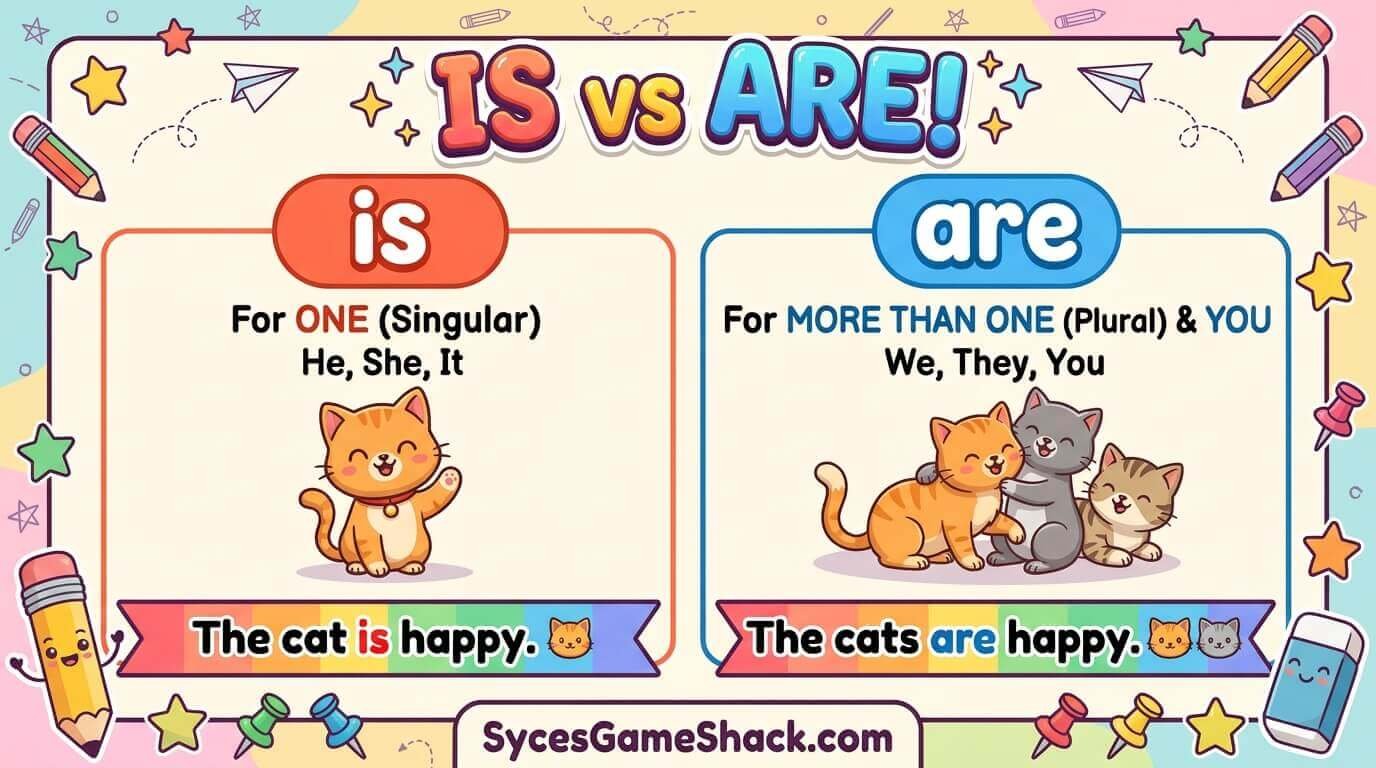
Use is with a singular subject (one person, place, thing, or idea) and with he, she, and it. Use are with a plural subject (more than one), and with you, we, and they.
- The dog is hungry. (one dog)
- The dogs are hungry. (more than one dog)
What Are “Is” and “Are”?
Both words are present-tense forms of the verb to be. This verb describes a state, condition, identity, or existence.
Which form you pick depends on the subject, which is why this topic is part of what grammar books call subject-verb agreement.
Present Tense of “To Be” at a Glance
| Subject | Verb | Example |
|---|---|---|
| I | am | I am ready. |
| You | are | You are right. |
| He / She / It | is | She is late. |
| We | are | We are friends. |
| They | are | They are here. |
| Singular noun | is | The book is new. |
| Plural noun | are | The books are new. |
The Core Rule: Find the Subject First
The most reliable method is to find the real subject, then decide if it is one thing or more than one. Follow these steps:
- Ask “who or what is doing or being?” That is your subject.
- Ignore extra phrases between the subject and the verb.
- Replace the subject with it or they.
- If it fits, use is. If they fit, use are.
Is vs Are With “You”
“You” always takes are, even when you mean just one person. Say “You are kind,” never “You is kind.”
Is vs Are in Questions and Negatives
| Type | With “Is” | With “Are” |
|---|---|---|
| Question | Is she ready? | Are they ready? |
| Negative | She is not ready. | They are not ready. |
| Contraction | She isn’t ready. | They aren’t ready. |
| Short answer | Yes, she is. | Yes, they are. |
“There Is” vs “There Are”
In sentences that begin with “there,” the subject comes after the verb. Look ahead to find it.
- There is a cat on the roof. (one cat)
- There are two cats on the roof. (two cats)
In casual speech, people often say “there’s” even before plural nouns, but in writing, match the verb to the noun that follows.
Is or Are With “And”
Two subjects joined by and usually take are.
- My brother and my sister are coming.
The exception is when the two items form one idea: “Rice and beans is my favorite meal.”
Is or Are With “Or” and “Nor”
When subjects are joined by or or nor, the verb agrees with the subject closest to it.
- Either the manager or the workers are responsible.
- Either the workers or the manager is responsible.
Is or Are With Phrases in Between
Phrases that sit between the subject and the verb do not change the verb.
- The box of chocolates is on the table. (subject: box)
- The teacher, along with her students, is visiting the museum.
- One of the boys is missing. (subject: one)
Indefinite Pronouns
| Always Singular (Is) | Always Plural (Are) | Depends on the Noun |
|---|---|---|
| everyone, everybody | both | some |
| someone, somebody | few | all |
| anyone, anybody | many | most |
| no one, nobody | several | any |
| each, either, neither | none |
- Everyone is invited.
- Both of the answers are correct.
- Some of the water is spilled. Some of the cookies are gone.
With “none” and “neither of,” modern English uses both singular and plural verbs. The singular is more formal, and the plural is more common in everyday speech.
Collective Nouns: Team, Family, Committee
A collective noun names a group. In American English, it usually takes is when the group acts as one unit.
- The team is ready for the final.
- The committee is meeting at noon.
British English often accepts are when the focus is on individual members: “The team is arguing among themselves.” Either is acceptable, but stay consistent in the same piece of writing.
Mass (Uncountable) Nouns
Words that name things you cannot count one by one are: water, sand, advice, information, news, furniture, and money.
- The information is helpful.
- The news is good today.
“A Number of” vs “The Number of”
| Phrase | Verb | Example |
|---|---|---|
| A number of | are | A number of students are absent. |
| The number of | is | The number of students is growing. |
| A group of | is | A group of tourists is waiting. |
| A pair of | is | A pair of shoes is by the door. |
Fractions, Percentages, and Amounts
For fractions and percentages, look at the noun after “of.”
- Half of the cake is gone. (cake is singular)
- Half of the cakes are gone. (cakes is plural)
- Twenty percent of the staff are remote workers.
Amounts of money, time, and distance are treated as one total: “Ten dollars is a fair price” and “Three miles is a long walk.”
Nouns That Look Plural but Are Singular
- School subjects and fields: Mathematics is hard. Economics is interesting.
- News: The news is on at six.
- Some diseases: Measles is contagious.
Nouns That Are Always Plural
Words for paired items are: scissors, jeans, glasses, pants, and trousers. Remember, “a pair of” changes this: “These scissors are sharp” but “This pair of scissors is sharp.”
“The police are investigating” is also plural, even though “police” has no -s.
Common Is vs Are Mistakes
| Incorrect | Correct | Why |
|---|---|---|
| The cats is sleeping. | The cats are sleeping. | Cats is plural. |
| The box of apples are heavy. | The box of apples is heavy. | The subject is box. |
| There is three books on the desk. | There are three books on the desk. | The subject is books. |
| Everyone is happy. | Everyone is happy. | Everyone is singular. |
| You is correct. | You are correct. | You always take ” are. |
| The news are bad. | The news is bad. | News is singular. |
Is and Are in Other Tenses
Once you master “is” and “are,” the other tenses follow the same logic of singular and plural:
| Tense | Singular | Plural |
|---|---|---|
| Present | She is happy. | They are happy. |
| Past | She was happy. | They were happy. |
| Future | She will be happy. | They will be happy. |
Is vs Are in Emails and Everyday Writing
In professional writing, agreement mistakes stand out quickly. Check these common spots before you send an email or publish a post:
- Subject lines and headlines. “Updates is ready” should be “Updates are ready.”
- Lists and bullet points. Make sure each item agrees with the verb that introduces it.
- Long sentences. The longer the sentence, the easier it is to lose track of the real subject.
- Questions. “Is the documents ready?” should be “Are the documents ready?”
Is vs Are vs Am
Svn ddo word am only with the pronoun I. Say “I am,” never “I is” or “I are.” In questions, it becomes “Am I late?”
Practice Quiz: Choose Is or Are
- The flowers ___ blooming.
- Each of the players ___ ready.
- There ___ a few seats left.
- My friends and I ___ going out tonight.
- The number of cars ___ increasing.
- Neither the teacher nor the students ___ happy.
- Mathematics ___ my favorite subject.
- A pair of gloves ___ on the shelf.
- Half of the pizza ___ left.
- The family ___moving next month.
Answers: 1. are, 2. is, 3. are, 4. are, 5. is, 6. are (nearest subject: students), 7. is, 8. is, 9. is, 10. is.
Quick Tips to Remember
- Find the subject before you choose the verb.
- Cross out phrases between the subject and the verb.
- Replace the subject with it or they to test your choice.
- In “there is” and “there are” sentences, check the noun that follows.
- Read the sentence aloud. Your ear often catches the mistake.
- When unsure, rewrite the sentence with a simpler subject and check again.
FAQs
1. What is the difference between is and are?
“Is” goes with singular subjects and he, she, it. “Are” goes with plural subjects and you, we, they.
2. Do we use is or are with “you”?
Always “are,” even for one person: “You are welcome.”
3. Is it “there is” or “there are”?
Use “there is” before a singular noun and “there are” before a plural noun.
4. Is “everyone” singular or plural?
Singular. Say “Everyone is here,” not “Everyone are here.”
5. Is “team” followed by is or are?
In American English, “The team is.” British English also accepts “The team are” when members act individually.
6. Is “news” singular or plural?
Singular. Say “The news is good.”
7. Do we use is or are with “a number of”?
“A number of” takes “are,” while “the number of” takes “is.”
8. Is “none” followed by is or are?
Both are accepted. “None of the students is late” is more formal, while “None of the students are late” is common in speech.
9. What is the contraction of “is not” and “are not”?
“Isn’t” and “aren’t.” For example: “She isn’t here” and “They aren’t here.”